Why Mountain
Asphalt
Fails.
Understanding the enemy is half the battle. Here's exactly what destroys pavement at altitude — and why waiting costs more.
Four Forces.
One Outcome: Failure.
At elevation, asphalt is exposed to a combination of stresses that flatland pavement never sees. Each one accelerates deterioration. Together, they cause complete pavement failure in just a few seasons of neglect.
Freeze-Thaw Expansion
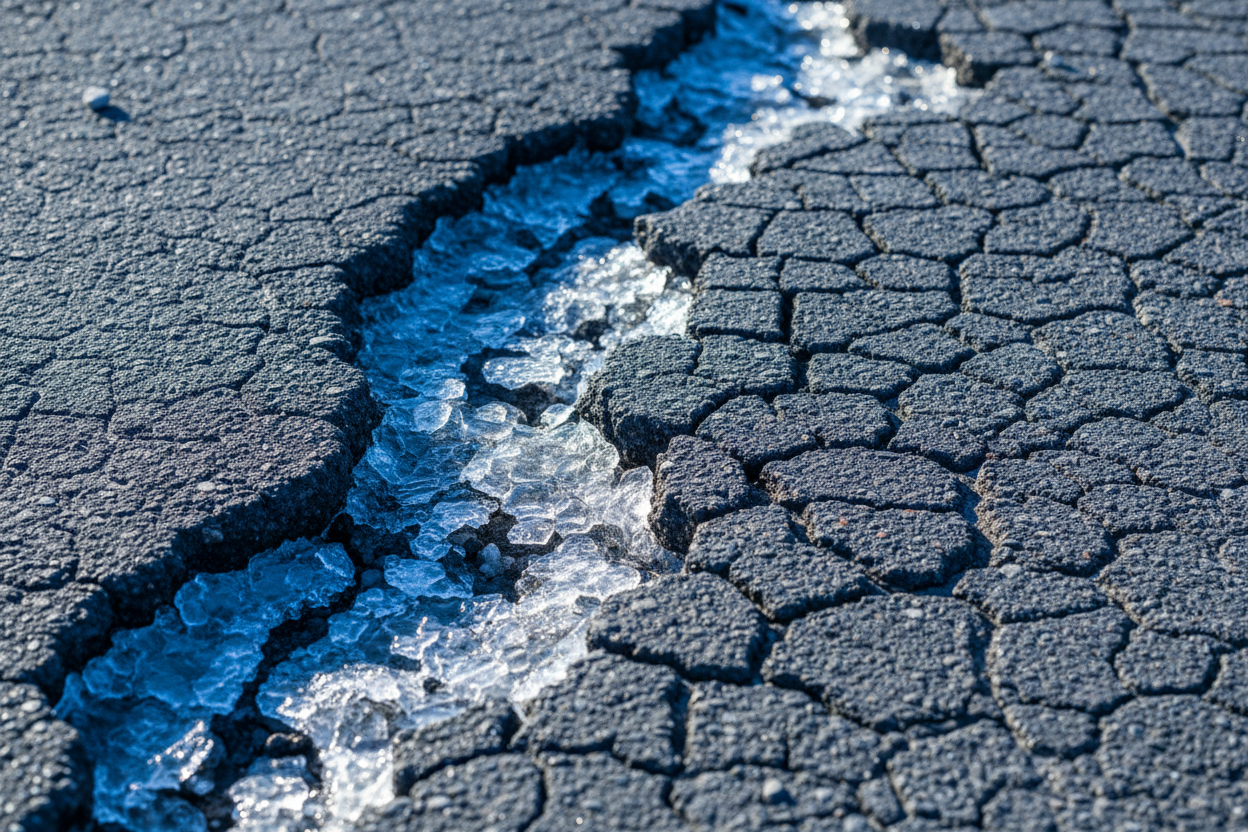
Summit County experiences more than 100 freeze-thaw cycles annually. When water in a crack freezes, it expands with 30,000 PSI of force — more than enough to pry asphalt apart from the inside.
Water Intrusion
Once water reaches the gravel base, the foundation of your driveway is compromised. Soft spots, sinking, and potholes follow. The base layer is what separates a driveway from a mud puddle.
High-Altitude UV
At 9,000+ feet, UV radiation is far more intense than at sea level. UV oxidizes the binders in asphalt, turning it grey, brittle, and porous. Brittle asphalt cracks easily under load.
Plow & Traffic Stress
Heavy snowplows, delivery trucks, and daily vehicle weight constantly flex the pavement. Maintained surfaces resist; oxidized, cracked surfaces snap and crumble.
One Crack.
Three Winters.
Surface Crack Appears
A small linear crack opens up — barely noticeable. Sealing now costs almost nothing and stops the entire chain reaction.
Water Reaches the Base
After one season of freeze-thaw, the crack has widened. Water has now penetrated the base layer. Soft spots begin forming.
Pothole & Base Failure
Alligator cracking spreads. A pothole opens. The structural base needs excavation and replacement before any resurfacing.
Maintenance is
Cheaper.
Always.
Crack filling and sealcoating every few seasons keep pavement in service condition for decades.
Tear-out and repaving runs into the tens of thousands. All because cracks were left open.
DON'T WAIT FOR THE NEXT WINTER.
Every freeze-thaw cycle compounds the damage. Get your project on the schedule now.